
The Health Insurance Code: An Engineer’s Guide to Financial Immunity in 2026
Think you're safe because you're healthy? Think again. From unlimited restoration to zero co-pay, here are the non-negotiable checks every 30-year-old must do before buying health insurance in India this year.
3/23/20262 min read
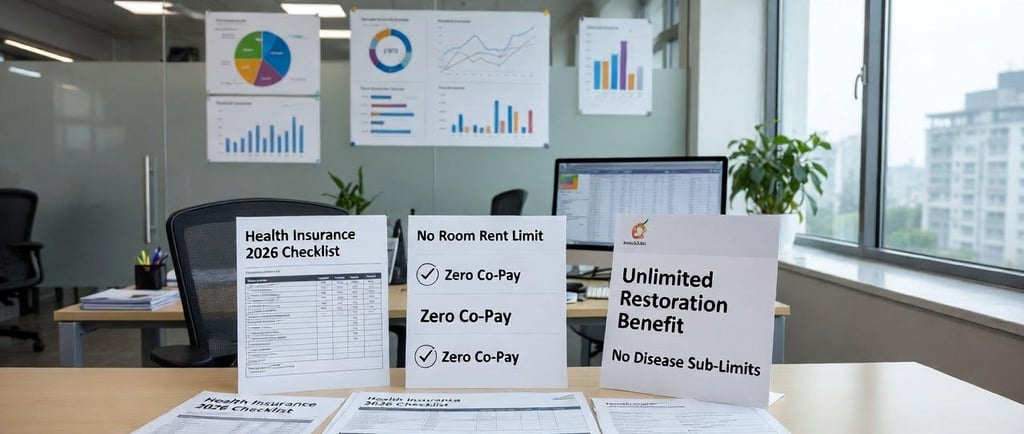
In the world of software, we never deploy code without a robust test suite. We don’t wait for a system crash to realize we need a backup. Yet, when it comes to our most important "hardware"—our health—many of us treat insurance as a "later" problem.
If you are in your 30s, healthy, and covered by a company policy, you might feel like buying personal insurance is a "waste of money." But in 2026, the logic has changed. With the latest 0% GST reforms and new IRDAI safety nets, insurance isn't just a cost; it’s a strategic asset.
Here is the "Technical Audit" of why you need to upgrade your health protection today.
1. The "Subscription" vs. "Asset" Logic
Your company health insurance is like a temporary license. It works as long as you are at the office, but the moment you resign or get laid off, your "access" is revoked.
A personal policy, however, is an Asset.
The No-Claim Bonus (NCB): Every year you stay healthy, your cover increases for free. A ₹10 Lakh policy can grow into a ₹30 Lakh cover in just 3 years.
The Waiting Period Clock: Most policies have a 2–3 year "latency" before they cover specific diseases. By starting at 30, you clear these "test cases" while you are healthy, ensuring you are 100% covered by the time you actually need it.
2. 2026 Update: The 0% GST Revolution
As of September 2025, the Indian government has made a landmark move: GST on individual and family health insurance is now 0% (down from 18%).
The Impact: This effectively makes your premium 18% cheaper than it was two years ago.
Pro Tip: If you were eyeing a ₹10 Lakh plan but settling for ₹5 Lakh due to cost, the 0% GST now allows you to "scale up" your coverage without breaking your budget.
3. The "Unbundled" Strategy: Insurance vs. Investment
A common mistake is mixing insurance with savings (like Endowment or Money-back plans). As an engineer, you know that Decoupling (unbundling) leads to better performance.
FeatureOption A: Combined (LIC-style)Option B: Unbundled (Term + SIP)Annual Outlay₹50,000₹12,000 (Insurance) + ₹38,000 (SIP)Protection₹10 Lakhs (Low)₹1 Crore (High)Returns~6% (Fixed)~12% (Market Avg)20-Year Value~₹21 Lakhs~₹30+ Lakhs
The Verdict: Buy a Pure Term Plan for life cover and a Comprehensive Health Plan for medical needs. Invest the rest in an Index Fund.
4. The Ultimate 2026 Checklist: What to Avoid vs. What to Choose
When "debugging" a policy document, don't just look at the premium. Check these critical parameters:
Feature🔴 WHAT TO AVOID🟢 WHAT TO CHOOSERoom Rent1% Cap (Leads to huge deductions)No Limit / Single Private RoomCo-payMandatory 10%–20%0% (Zero Co-pay)RestorationOnce a year / LimitedUnlimited / Multi-restorationConsumablesExcluded (Gloves, masks, etc.)Included (or as an add-on)Wait Periods> 3 years1–2 YearsPre/Post Hospital<30 days / <60 days60 days / 180 daysCSR (Claims)Below 90%95% +
5. Final Logic: Why "Low Cost" is High Risk
Thinking "I'll take the cheapest plan since I'm healthy" is a bug in your financial logic.
Cheap plans often have Room Rent Caps.
If your room costs ₹6,000 but your plan allows ₹3,000, the insurer might cut 50% of your entire bill (including the surgeon's fee!).
The Fix: Aim for "High Value," not just "Low Cost." A Base + Top-up combination can give you ₹20 Lakhs of cover for the price of a coffee per day.
Conclusion
In the software world, we say: "Fail early, fail often." In life, we want the opposite. Buying health insurance at 30 is about ensuring that a medical emergency doesn't "crash" your financial system.
Ready to audit your current coverage? Check your company policy today for "Room Rent Limits"—it might be the biggest bug in your financial plan.
Location
91 88090909xx
abhishekcpj@gmail.com
Hours
Mon-Fri 8:00-11:00
Sat-Sun 9:00 to 21:00
Contacts
+91 88090909xx
abhishekcpj@gmail.com